
Stock photos no longer cut it when your B2B landing page visual design needs to build real trust fast. You know your prospects spot generic images in seconds, and that kills conversion rates. An authentic visual marketing strategy using brand storytelling images can change the game—and raise your custom photography conversion rate optimization well above industry averages. Let’s break down why real photos beat stock photo vs real photos conversion every time.
The Trust Gap in B2B Visual Communication
Your enterprise prospects are sophisticated buyers. They review dozens of vendor websites before making contact, and they can identify stock photography within milliseconds. This instant recognition creates an immediate credibility problem that undermines your entire sales process.
Research shows that B2B buyers spend 27% more time on pages featuring authentic imagery compared to those using generic stock photos. The reason is simple: real photos communicate that your company has real clients, real projects, and real results. When decision-makers are evaluating six-figure purchases, these visual trust signals matter significantly.
The disconnect between stock imagery and actual business operations creates cognitive dissonance. Your prospect reads about your specialized manufacturing capabilities while looking at a photo of models in lab coats who have never set foot in your facility. This mismatch between message and visual evidence erodes confidence at the exact moment you need to build it.
Understanding Custom Photography Conversion Rate Optimization
Custom photography conversion rate optimization begins with recognizing that every image on your site either builds trust or destroys it. There is no neutral ground in B2B visual marketing. When you invest in professional photography of your actual team, facilities, and clients, you create conversion assets that compound in value over time.
The data supporting custom photography is compelling. A/B testing across multiple B2B industries reveals that landing pages featuring authentic company imagery convert 35% to 45% better than identical pages using stock photos. For high-value B2B transactions, this difference translates directly to revenue impact measured in millions.
Your custom photography serves multiple conversion functions simultaneously. It validates your company’s legitimacy, demonstrates your operational capacity, showcases your team’s expertise, and provides social proof through real client interactions. Stock photos accomplish none of these objectives because they lack specificity and authenticity.
Building Your Authentic Visual Marketing Strategy
An authentic visual marketing strategy requires intentional planning and execution. You cannot simply hire a photographer for an afternoon and expect conversion-worthy results. The most effective B2B visual strategies align photography objectives with specific conversion goals at each stage of the buyer journey.
Start by auditing your current visual assets. Identify every page where prospects make decisions: your homepage, service pages, case studies, about page, and contact forms. These high-stakes pages demand your best visual evidence. Generic imagery on these pages actively works against your conversion objectives.
Next, map your visual needs to your unique value propositions. If you emphasize technical expertise, you need photos of your team solving complex problems. If you highlight manufacturing capabilities, you need shots that showcase your facility’s scale and sophistication. If client relationships are central to your positioning, you need images that capture authentic collaboration.
Your photography planning should account for long-term asset development. A single comprehensive shoot can generate 200 to 300 usable images that serve your marketing needs for 18 to 24 months. This approach is far more cost-effective than repeated small shoots and ensures visual consistency across all channels.
The Economics of Stock Photo vs Real Photos Conversion
The stock photo vs real photos conversion debate ultimately comes down to return on investment. While stock photography appears less expensive upfront, the hidden costs accumulate quickly when you factor in reduced conversion rates and diminished brand differentiation.
Consider a B2B company generating 10,000 qualified landing page visits per month with an average deal value of $50,000. If stock photography produces a 2% conversion rate while custom photography achieves 2.8%, the revenue difference is $2 million annually. The investment in professional photography typically ranges from $5,000 to $15,000 for a comprehensive shoot, creating an extraordinary return.
Beyond direct conversion impact, custom photography provides competitive differentiation that stock images cannot deliver. When your competitors all use the same stock photo libraries, your authentic imagery immediately distinguishes your brand. This visual differentiation reinforces your positioning and makes your company more memorable throughout the extended B2B sales cycle.
The licensing limitations of stock photography create additional hidden costs. You may discover that your competitor is using the same image, forcing you to replace it. Custom photography provides exclusive visual assets that competitors cannot replicate, giving you permanent ownership of your visual brand identity.
B2B Landing Page Visual Design Best Practices
B2B landing page visual design requires a different approach than B2C. Your prospects are analytical, skeptical, and focused on risk mitigation. Every design element must address these psychological factors while moving prospects toward conversion actions.
Hero images set the tone for your entire page. Instead of aspirational stock photos of handshakes and skylines, use authentic images that immediately communicate your specific value. A manufacturing company should show their actual production floor. A consulting firm should feature their real team collaborating with clients. Specificity builds credibility.
Supporting images throughout your landing page should reinforce key messages with visual evidence. When you describe your quality control process, show your team conducting inspections. When you mention your technology infrastructure, photograph your actual systems. This alignment between written claims and visual proof accelerates trust development.
People photography deserves special attention in B2B contexts. Prospects want to see the actual humans they will work with, not models pretending to be professionals. Authentic team photos, especially those showing your people in action, create emotional connections that facilitate business relationships. The goal is not glossy perfection but genuine representation.
Environmental photography of your facilities, offices, and workspaces provides powerful social proof. These images answer unspoken questions about your operational capacity and professionalism. A prospect evaluating a $500,000 software implementation needs visual confirmation that your company has the infrastructure to support their needs.
Creating Effective Brand Storytelling Images
Brand storytelling images go beyond simple documentation to communicate your company’s narrative, values, and culture. These images work on an emotional level while still maintaining B2B professionalism and credibility.
The most effective brand storytelling images capture authentic moments rather than staged scenarios. A photo of your team genuinely celebrating a project milestone tells a more compelling story than a posed group shot. Real client interactions, candid team collaboration, and unscripted problem-solving moments all create narrative depth that resonates with prospects.
Your brand story should be visible across your image library. If you position your company as technically sophisticated, your photos should consistently show advanced technology, complex projects, and expert team members. If your brand emphasizes client partnership, your imagery should feature collaborative interactions and long-term relationships.
Sequential storytelling through photography can guide prospects through your process. A series of images showing a project from initial consultation through implementation and results provides a visual journey that helps prospects envision working with you. This approach works particularly well in case studies and service pages.
Cultural photography that captures your team’s personality and work environment helps prospects assess fit. B2B relationships are long-term commitments, and buyers want to work with companies whose values and culture align with their own. Authentic workplace photos provide these important signals without requiring explicit statements.
Technical Considerations for Conversion-Focused Photography
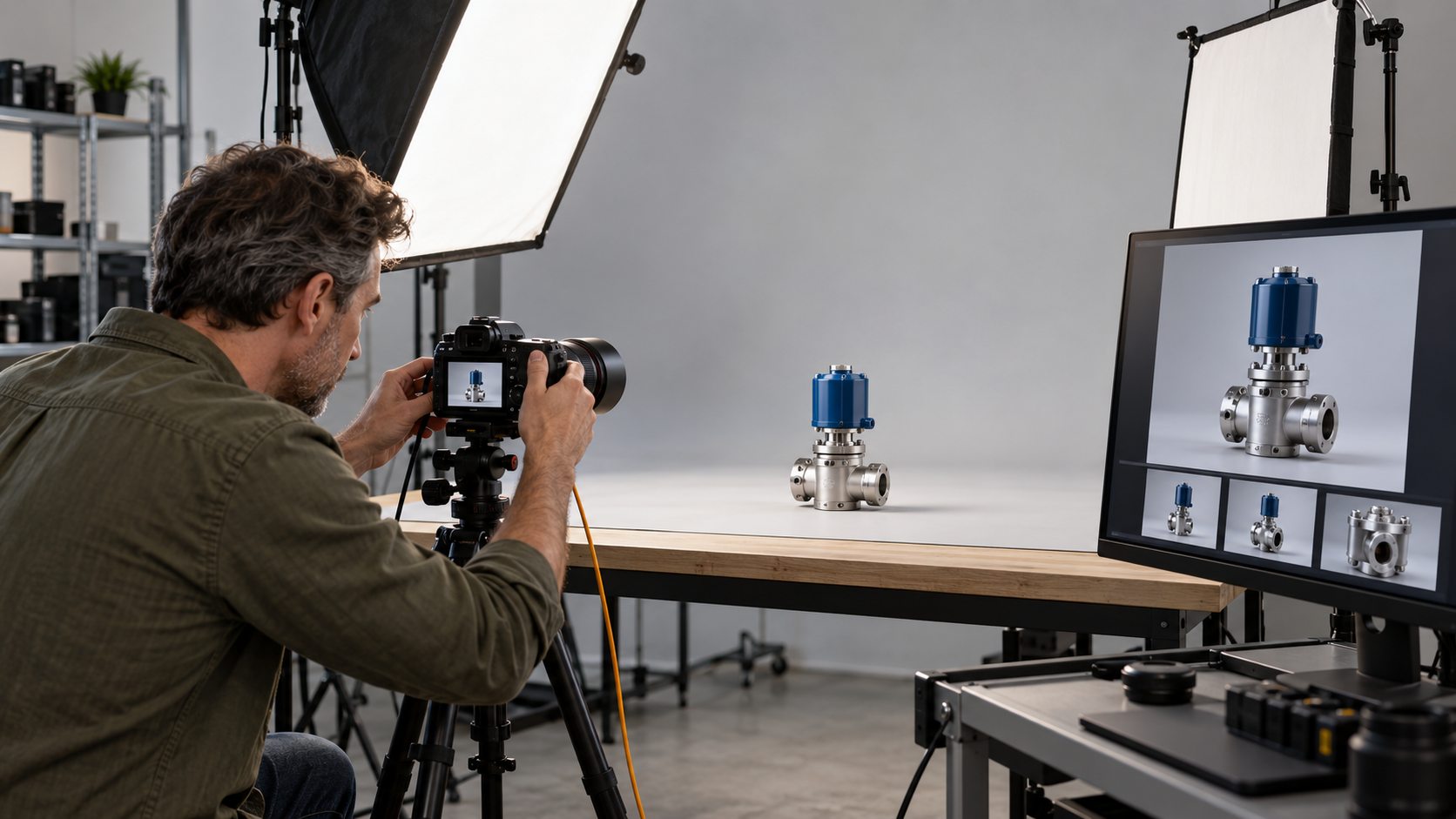
Professional photography for conversion requires technical excellence in addition to authentic content. Poor image quality undermines credibility just as surely as stock photos do. Your visual assets must meet high technical standards while maintaining authenticity.
Lighting quality separates professional photography from amateur snapshots. Proper lighting reveals detail, creates depth, and establishes mood. For B2B applications, lighting should be clean and professional without appearing overly stylized. The goal is to present your business in its best light while maintaining realistic representation.
Composition guides viewer attention to conversion-relevant elements. Professional photographers use framing, perspective, and focal points to emphasize what matters most in each image. In a manufacturing photo, composition might highlight precision equipment. In a team photo, composition ensures key personnel are prominently featured.
Image resolution and file preparation affect both visual quality and site performance. High-resolution originals allow you to use images across multiple channels, from websites to print materials, without quality degradation. Proper file compression ensures fast page loading without visible quality loss, protecting both user experience and search rankings.
Consistency across your image library creates visual cohesion that strengthens brand identity. While you want authentic variety, maintaining consistent color grading, lighting style, and compositional approach helps all your images feel like part of a unified brand system rather than a random collection.
Implementation Strategy for Maximum Impact
Implementing your authentic visual marketing strategy requires a phased approach that prioritizes high-impact pages while building a comprehensive asset library over time. Start with the pages that receive the most traffic and influence the most conversions.
Your homepage typically receives the highest traffic and forms first impressions. Replacing stock imagery here with authentic photography should be your first priority. Focus on hero images, team introductions, and any visual elements above the fold that prospects see immediately upon arrival.
Service and product pages are where prospects evaluate your specific offerings. These pages need detailed visual evidence of your capabilities. Before and after photos, process documentation, and technical details all benefit from custom photography that shows your actual work rather than generic representations.
Case studies and testimonials gain enormous credibility from authentic photography. Images of real clients, actual project sites, and documented results transform case studies from marketing claims into verifiable evidence. When possible, photograph clients in their environments using your solutions.
About and team pages build the human connections that facilitate B2B relationships. Stock photos of generic business people actively harm these pages by highlighting your lack of authenticity. Real team photos, even if less polished than stock images, build far more trust and connection.
Measuring Visual Marketing Performance
Your authentic visual marketing strategy requires ongoing measurement to validate investment and guide refinement. Several metrics provide insight into how your photography affects conversion performance.
Direct A/B testing offers the clearest evidence of visual impact. Test identical landing pages with only the imagery changed, measuring conversion rates, time on page, and bounce rates. This controlled comparison isolates the effect of authentic photography versus stock images on prospect behavior.
Heat mapping and scroll tracking reveal how prospects interact with your visual content. Do they pause on your team photos? Do they scroll past stock images without engagement? This behavioral data shows which images capture attention and which are ignored.
Conversion funnel analysis by traffic source can reveal how different prospect segments respond to your imagery. Enterprise buyers may respond differently to authentic photography than small business prospects. Understanding these patterns helps you optimize visual strategies for your most valuable segments.
Page-level conversion rate changes following image updates provide clear before-and-after evidence of impact. When you replace stock photography with custom images on a service page, track conversion changes over the following 30 to 60 days to measure the effect.
Qualitative feedback from sales conversations offers valuable insight into how prospects perceive your visual marketing. Sales teams often hear comments about website imagery that reveal how visuals influence trust and credibility during the evaluation process.
Overcoming Common Implementation Challenges
Many B2B companies recognize the value of custom photography but face obstacles in implementation. Understanding these challenges and their solutions helps you move forward with confidence.
Budget concerns are the most common barrier. When you frame photography as a conversion investment rather than a marketing expense, the ROI becomes clear. Calculate the revenue value of even modest conversion rate improvements to justify the investment. For most B2B companies, a single additional deal covers the entire photography cost.
Coordination challenges arise when scheduling shoots around operational demands. Your team is busy, your facilities are in use, and finding time for photography feels disruptive. The solution is treating photography as a strategic project with dedicated planning, clear scheduling, and executive support.
Privacy and confidentiality concerns are legitimate in many B2B contexts. You may work in secure facilities, handle sensitive client information, or operate in regulated industries. Professional photographers experienced in B2B work understand these constraints and can create authentic imagery while respecting necessary boundaries.
Perfectionism can prevent companies from moving forward with photography. You worry that your facility isn’t impressive enough, your team isn’t photogenic enough, or your work isn’t visually interesting enough. This thinking misses the point: authenticity matters more than perfection. Your prospects want to see the real company they will work with, not an idealized fantasy.
Future-Proofing Your Visual Marketing Assets
Your custom photography investment should serve your business for years, not months. Strategic planning ensures your visual assets remain relevant and effective as your business grows and markets change.
Scalability should guide your photography planning. Shoot more content than you currently need, capturing variety in settings, people, and activities. This library approach gives you fresh imagery to rotate through your site, keeping your visual presence current without constant new shoots.
Seasonal and temporal flexibility matter in photography planning. Avoid imagery that will quickly date your site, such as specific technology that will soon be obsolete or fashion that will look dated within a year. Focus on timeless representations of your core capabilities and values.
Modular photography allows you to update specific elements without reshooting everything. If your team changes, you can add new team member photos to your existing library. If you expand facilities, you can supplement existing environmental shots with new spaces. This modular approach makes your visual assets more adaptable.
Rights management and asset organization protect your investment over time. Maintain original high-resolution files with proper metadata, organization, and backup. Ensure you have full usage rights for all photography without time limits or additional licensing fees. These practices protect your ability to use your assets across all channels indefinitely.
The Competitive Advantage of Visual Authenticity
In an increasingly crowded B2B marketplace, authentic photography provides a sustainable competitive advantage. While competitors can copy your messaging, they cannot replicate your authentic visual story.
Visual differentiation becomes more valuable as content marketing saturates B2B spaces. Your prospects read similar blog posts, see similar service descriptions, and hear similar value propositions from multiple vendors. Authentic photography cuts through this sameness by showing rather than telling what makes you different.
The compound effect of visual authenticity extends beyond individual conversions. Prospects who see authentic imagery are more likely to remember your brand, more likely to return to your site, and more likely to recommend you to colleagues. These secondary effects multiply the value of your photography investment.
Brand equity building through consistent authentic imagery creates long-term value that stock photography cannot match. Over time, your visual identity becomes associated with quality, professionalism, and trustworthiness. This brand equity reduces acquisition costs and increases customer lifetime value.
Taking Action on Your Visual Strategy
Understanding the value of custom photography conversion rate optimization is only the first step. Implementation requires commitment, planning, and execution. The companies that move quickly on visual strategy gain advantages that compound over time.
Begin with a comprehensive visual audit of your current digital presence. Identify every instance of stock photography, particularly on high-value conversion pages. Prioritize these pages for custom photography replacement based on traffic volume and conversion value.
Develop a detailed shot list that aligns with your conversion objectives. What specific images do you need to support your value propositions? What visual evidence will address prospect objections? What authentic moments will communicate your brand story? This planning ensures your photography shoot delivers maximum conversion value.
Select a photographer with B2B experience who understands business environments and professional imagery requirements. Review portfolios specifically for work with companies similar to yours. The right photographer will understand how to capture authentic moments while maintaining the professional standards B2B prospects expect.
Schedule your photography project with adequate time for planning, shooting, and post-production. Rush jobs produce mediocre results. A well-planned shoot with proper preparation delivers assets that serve your business for years.
Your authentic visual marketing strategy represents one of the highest-return investments available in B2B marketing. The difference between stock photo vs real photos conversion is not marginal but transformational. When your prospects see real people, real facilities, and real work, they develop the trust necessary to move forward with high-value business relationships.
The question is not whether custom photography delivers better results than stock images. The evidence is clear and overwhelming. The only question is when you will make this strategic investment in your conversion performance. Every day you delay is another day your competitors can move ahead with visual authenticity while you remain trapped in the credibility-destroying world of generic stock photography.
Your prospects are ready to trust you. They want to believe your capabilities match your claims. They need visual evidence to overcome their natural skepticism about vendor promises. Custom photography provides this evidence in the most powerful form possible: authentic images of your actual business in action.
The path forward is clear. Audit your current visual assets, plan your photography strategy, and execute with professional excellence. The conversion improvements, competitive advantages, and brand equity gains will validate your investment many times over. Your B2B landing page visual design will finally match the quality of your actual business, and your conversion rates will reflect that alignment.
Brand storytelling images created through authentic photography do not just improve metrics. They change how prospects perceive your entire organization. They transform your website from a marketing brochure into a window into your real business. This transparency builds the foundation for long-term client relationships that drive sustainable business growth.
The companies winning in B2B markets today understand that trust is the ultimate conversion factor. In an environment where prospects are increasingly skeptical of marketing claims and overwhelmed by similar-sounding vendors, authentic visual evidence breaks through the noise. Your custom photography becomes your most persuasive sales tool, working 24/7 to build credibility with every prospect who visits your site.
Make the commitment to visual authenticity. The return on this investment will exceed your expectations and provide competitive advantages that extend far beyond immediate conversion rate improvements. Your prospects deserve to see the real company they are considering as a partner. Give them that transparency, and they will reward you with their trust and their business.
Frequently Asked Questions
Why does custom photography convert better than stock photos in B2B marketing?
Custom photography converts better because it provides authentic visual evidence of your actual capabilities, team, and facilities. B2B buyers are sophisticated and can identify stock photos instantly, which creates credibility concerns. Real photos of your business operations validate your claims and build the trust necessary for high-value business decisions. Studies show conversion rate improvements of 35% to 45% when authentic imagery replaces stock photos on B2B landing pages.
How much should a B2B company invest in professional custom photography?
A comprehensive professional photography shoot for B2B purposes typically costs between $5,000 and $15,000, depending on scope and complexity. This investment generates 200 to 300 usable images that serve your marketing needs for 18 to 24 months. When you calculate the revenue value of even modest conversion rate improvements, a single additional deal often covers the entire photography cost, making the ROI extremely favorable for most B2B companies.
What types of custom photos are most important for B2B landing pages?
The most important custom photos for B2B landing pages include authentic team photography showing the actual people prospects will work with, facility and environmental shots that demonstrate operational capacity, process documentation that provides visual evidence of your methods, and real client interaction images that offer social proof. Hero images on your homepage and service pages deserve particular attention, as these form first impressions and influence conversion decisions most directly.
How can we measure the impact of switching from stock photos to custom photography?
Measure the impact through direct A/B testing of identical pages with only imagery changed, tracking conversion rates, time on page, and bounce rates. Page-level conversion rate changes before and after image updates provide clear evidence over 30 to 60 day periods. Heat mapping shows how prospects interact differently with authentic versus stock imagery. Additionally, monitor conversion funnel performance and gather qualitative feedback from your sales team about how prospects respond to your visual content.
What are the biggest mistakes B2B companies make with visual marketing?
The biggest mistakes include using generic stock photography that undermines credibility, waiting for perfect conditions instead of capturing authentic moments, failing to align imagery with specific value propositions, shooting insufficient variety during photography sessions, and neglecting to replace stock images on high-traffic conversion pages. Many companies also make the mistake of treating photography as a one-time expense rather than a strategic asset that requires proper planning, rights management, and ongoing use across multiple channels.
How Elevated Marketing can help
We do this work every day for businesses in Indianapolis, the DC & Virginia metro, and nationwide.
→ Website Security & Monitoring→ SEO & GEO Services→ Managed Web Hosting→ More on UncategorizedGet a free audit