
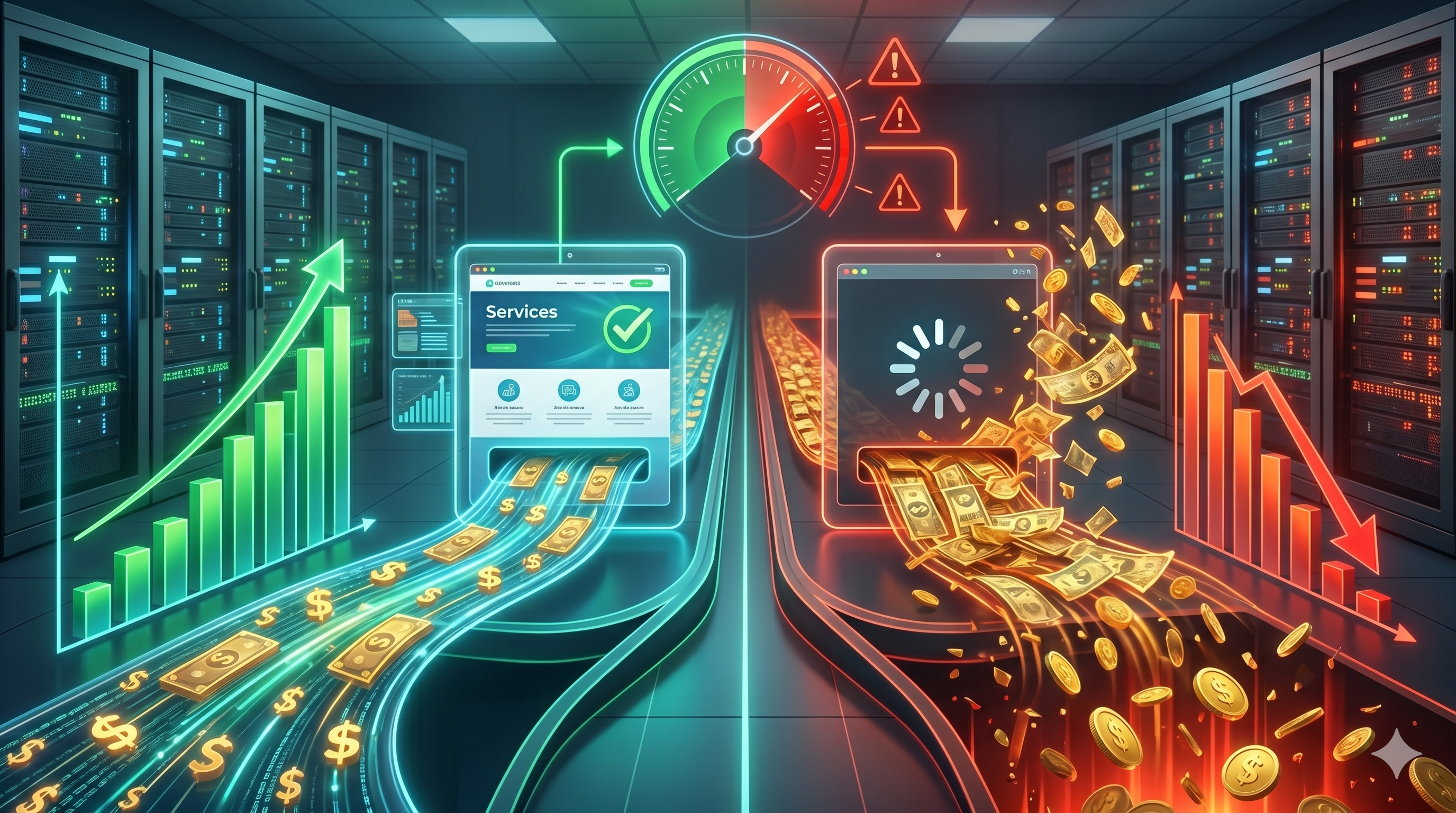
Most Google Ads budgets vanish before a page fully loads. You pour money into clicks, only to lose customers stuck on slow landing pages. Improving your landing page load speed can make a huge difference in your results, and in this post, you’ll learn how focusing on Core Web Vitals for paid search and fast web hosting PPC can reduce bounce rate ads and optimize Google Ads ROI.
The Real Cost of Slow Landing Pages
Every second your landing page takes to load costs you money. When a potential customer clicks your Google Ads campaign, they expect immediate results. Research shows that 53% of mobile users abandon sites that take longer than three seconds to load. For e-commerce businesses and media buyers running paid campaigns, this statistic translates directly into wasted advertising spend.
Your Google Ads Quality Score depends partly on landing page experience. Google monitors how users interact with your pages after clicking ads. When visitors bounce because of slow load times, your Quality Score drops, driving up your cost per click and reducing ad placement. This creates a cycle where poor landing page load speed continuously drains your budget while delivering diminishing returns.
The financial impact extends beyond wasted clicks. Consider a scenario where you spend $10,000 monthly on Google Ads with a 40% bounce rate caused by slow pages. You’re effectively throwing away $4,000 every month before prospects even see your offer. Over a year, that’s $48,000 in lost opportunity.
Understanding Core Web Vitals for Paid Search
Google introduced Core Web Vitals as measurable metrics for user experience. These metrics directly influence both organic search rankings and the performance of paid search campaigns. For media buyers focused on conversion optimization, understanding Core Web Vitals for paid search is essential.
Largest Contentful Paint (LCP)
LCP measures loading performance. It tracks how long your main content takes to become visible. Google recommends an LCP of 2.5 seconds or less. When your landing pages exceed this threshold, visitors perceive your site as slow, triggering higher bounce rates. For paid traffic where every click costs money, poor LCP scores directly reduce your return on investment.
First Input Delay (FID)
FID quantifies interactivity. It measures the time from when a user first interacts with your page to when the browser responds. Users expect responsive interfaces. When buttons don’t click or forms don’t respond immediately, frustration builds. A good FID score is less than 100 milliseconds. Exceeding this creates friction that converts paid clicks into abandoned sessions.
Cumulative Layout Shift (CLS)
CLS tracks visual stability. Nothing frustrates users more than clicking a button only to have the page shift and register an unintended action. A CLS score below 0.1 is considered good. High CLS scores on landing pages cause users to distrust your site, particularly problematic when they’ve just clicked a paid ad and are evaluating whether to trust your business with their money.
How Landing Page Load Speed Affects Quality Score
Google Ads Quality Score combines expected click-through rate, ad relevance, and landing page experience. The landing page experience component directly correlates with page speed metrics. When you improve landing page load speed, you enhance the user experience Google evaluates when calculating your Quality Score.
A higher Quality Score reduces your cost per click while improving ad position. This means you pay less for better placement. The compounding effect is substantial. A Quality Score improvement from 5 to 7 can reduce costs by 28.6% while improving average ad position. For campaigns spending thousands monthly, these savings accumulate quickly.
Google’s algorithms detect when users immediately bounce back to search results after clicking ads. This “pogo-sticking” behavior signals poor landing page quality. Slow load times are a primary cause. When you reduce bounce rate ads through faster loading pages, you signal to Google that your landing page satisfies user intent, directly improving your Quality Score.
The Technical Foundation: Fast Web Hosting PPC
Your hosting infrastructure forms the foundation of page speed. Many businesses overlook this critical element when launching paid campaigns. Choosing fast web hosting PPC solutions specifically designed for high-performance landing pages can dramatically improve conversion rates.
Server Response Time
Time to First Byte (TTFB) measures how quickly your server responds to requests. Shared hosting environments often struggle with TTFB, particularly during traffic spikes from successful ad campaigns. When you run paid traffic, you need hosting that scales. A TTFB under 200 milliseconds is ideal. Anything over 600 milliseconds creates noticeable delays that impact user experience.
Content Delivery Networks
CDNs distribute your content across global servers, delivering pages from locations nearest to your users. For businesses running international campaigns or targeting nationwide audiences, CDNs reduce latency significantly. A user in California accessing a server in New York experiences inherent delays. CDNs eliminate this geographic bottleneck, ensuring fast page loads regardless of visitor location.
Resource Allocation
Dedicated resources prevent performance degradation during traffic surges. When your Google Ads campaign performs well and drives substantial traffic, shared hosting resources become contested. Your landing pages slow down precisely when you need peak performance. Fast web hosting PPC solutions provide dedicated CPU, RAM, and bandwidth that maintain consistent speed under load.
Strategies to Reduce Bounce Rate Ads

High bounce rates directly correlate with poor campaign performance. When visitors leave immediately after clicking your ads, you pay for clicks without generating conversions. Implementing strategies to reduce bounce rate ads improves every metric that matters: conversion rate, cost per acquisition, and overall ROI.
Image Optimization
Images typically constitute the largest portion of page weight. Unoptimized images are the most common culprit behind slow landing pages. Compress images without sacrificing quality using modern formats like WebP. Implement lazy loading so images below the fold load only when users scroll. These techniques reduce initial page weight, accelerating the critical first paint that determines whether users stay or bounce.
Minimize JavaScript Execution
Excessive JavaScript blocks page rendering. Every script must be downloaded, parsed, and executed before users see content. Audit your landing pages for unnecessary scripts. Remove third-party tracking codes that don’t directly contribute to conversion optimization. Defer non-critical JavaScript to load after the main content appears. This prioritization ensures users see your value proposition immediately, reducing bounce likelihood.
Critical CSS Inline
CSS files delay rendering while browsers download and parse them. Inline critical CSS directly in your HTML for above-the-fold content. This allows browsers to render visible content immediately without waiting for external stylesheets. Users perceive pages as loading faster when they see content quickly, even if background resources are still loading.
Reduce Server Requests
Each resource on your page requires a separate server request. Fonts, images, scripts, and stylesheets all add requests that accumulate delay. Combine files where possible. Use CSS sprites for multiple images. Limit the number of fonts and font weights. Every eliminated request shaves milliseconds off load time, and these savings compound across thousands of ad clicks.
Mobile Optimization for Paid Traffic
Mobile users represent an increasingly large portion of paid search traffic. Mobile devices have less processing power and often rely on cellular connections with higher latency than broadband. Optimizing landing page load speed for mobile users is not optional.
Responsive Design Considerations
Responsive design adapts layouts to different screen sizes. Poor implementations load full desktop resources then hide elements with CSS. This approach wastes bandwidth and processing power. Design mobile experiences that load only necessary resources. Use responsive images that serve appropriately sized files based on device capabilities.
Accelerated Mobile Pages
AMP is a framework that prioritizes speed on mobile devices. While controversial in some circles, AMP pages load nearly instantaneously. For paid search campaigns where every fraction of a second impacts conversion rates, AMP landing pages can provide competitive advantages. The framework enforces best practices that eliminate common performance pitfalls.
Touch-Friendly Interfaces
Mobile users interact through touch, requiring larger tap targets and simplified navigation. Complex layouts that work on desktop create friction on mobile. When users struggle to interact with your landing page after clicking an ad, they abandon the session. Design touch-first experiences that minimize interaction cost, keeping users engaged long enough to convert.
Measuring and Monitoring Performance
You cannot improve what you don’t measure. Establishing baseline metrics and continuously monitoring performance reveals opportunities to optimize Google Ads ROI through speed improvements.
Google PageSpeed Insights
This free tool analyzes your landing pages and provides specific recommendations. It reports on Core Web Vitals for paid search and identifies issues impacting performance. Run PageSpeed Insights on all landing pages receiving paid traffic. Prioritize fixes based on the impact scores provided.
Real User Monitoring
Lab tests provide controlled environments, but real user monitoring captures actual performance experienced by your customers. Tools like Google Analytics and specialized performance monitoring solutions track real-world metrics. This data reveals how different devices, browsers, and connection speeds affect your landing page load speed.
A/B Testing Speed Improvements
Test speed optimizations the same way you test copy and design changes. Create variations with different performance characteristics and measure conversion impact. This empirical approach quantifies the ROI of speed improvements, justifying the technical investment required.
The Business Case for Speed Investment
Improving landing page load speed requires time and resources. Media buyers and e-commerce owners need clear ROI justification for technical investments. The business case becomes compelling when you calculate the cumulative impact.
Conversion Rate Improvements
Studies consistently show that faster pages convert better. Amazon found that every 100ms of latency cost them 1% in sales. For an e-commerce business generating $1 million annually, a 1-second speed improvement could yield $100,000 in additional revenue. When you factor in the cost of paid traffic driving those conversions, the ROI multiplies.
Reduced Advertising Costs
Better Quality Scores from improved landing page experience reduce cost per click. If you currently spend $50,000 monthly on Google Ads with an average Quality Score of 6, improving to an average of 8 through speed optimization could reduce costs by approximately 20%, saving $10,000 monthly or $120,000 annually.
Competitive Advantages
Your competitors likely neglect landing page speed. By prioritizing performance, you create differentiation that compounds over time. Faster pages mean better Quality Scores, lower costs, and higher conversion rates. This combination allows you to bid more aggressively while maintaining profitability, capturing market share from slower competitors.
Implementation Roadmap
Translating strategy into action requires a structured approach. This roadmap provides a practical sequence for improving landing page performance.
Phase 1: Audit and Baseline
Begin by auditing current performance. Document load times, Core Web Vitals scores, and bounce rates for all landing pages receiving paid traffic. Establish clear baselines against which you’ll measure improvements. Identify the worst-performing pages that receive the most paid traffic as priority targets.
Phase 2: Quick Wins
Implement changes that deliver immediate improvements with minimal effort. Compress images, enable caching, and minify CSS and JavaScript. These technical optimizations typically yield 20-30% speed improvements within days. Deploy these changes and measure impact on bounce rates and conversion rates.
Phase 3: Infrastructure Improvements
Evaluate your hosting environment. If you’re on shared hosting or outdated infrastructure, migrate to fast web hosting PPC solutions designed for performance. Implement a CDN if you haven’t already. These foundational changes require more investment but deliver sustained performance improvements that benefit all traffic, not just paid campaigns.
Phase 4: Advanced Optimization
After addressing foundational issues, pursue advanced optimizations. Implement lazy loading, critical CSS inlining, and resource prioritization. Consider frameworks like AMP for mobile landing pages. These refinements extract maximum performance from your technical stack.
Phase 5: Continuous Monitoring
Speed optimization is not a one-time project. Regular monitoring identifies performance regressions before they impact campaigns. Establish alerts for when Core Web Vitals exceed thresholds. Review performance metrics monthly, treating speed as a key performance indicator alongside conversion rate and cost per acquisition.
Common Pitfalls to Avoid
Many businesses make predictable mistakes when addressing landing page speed. Avoiding these pitfalls saves time and prevents performance regressions.
Over-Reliance on Plugins
WordPress and other CMS platforms offer countless performance plugins. While some provide value, excessive plugins create their own performance problems. Each plugin adds code that must be loaded and executed. Audit plugins regularly, removing any that don’t provide clear value. Prefer manual optimization over plugin-based solutions when possible.
Ignoring Mobile Performance
Desktop testing reveals only part of the picture. A page that loads quickly on a desktop computer with broadband may crawl on a mobile device over 4G. Test on actual mobile devices under realistic network conditions. Tools like Chrome DevTools can simulate mobile networks, revealing performance issues invisible on desktop.
Premature Optimization
Not all performance improvements deliver equal ROI. Spending weeks optimizing a landing page that receives 10 clicks monthly wastes resources. Prioritize pages based on traffic volume and conversion value. Focus on the 20% of pages that generate 80% of your paid traffic results.
Neglecting Content Changes
Design and content teams often add elements that degrade performance. A marketing manager adds a video background without considering the multi-megabyte file size. A designer implements a custom font that requires multiple requests. Establish performance budgets that constrain page weight and load time, preventing well-intentioned changes from eroding speed.
Advanced Techniques for Media Buyers
Media buyers managing multiple campaigns and landing pages benefit from sophisticated approaches to performance management.
Dynamic Landing Page Generation
Create landing pages programmatically based on campaign parameters. This allows you to generate lightweight, focused pages for specific ad groups without maintaining dozens of separate templates. Dynamic generation enables personalization while maintaining performance standards across all variations.
Performance-Based Routing
Implement logic that directs traffic based on device capabilities and connection speed. Users on slow connections receive stripped-down versions optimized for minimal bandwidth. Users on fast connections get full-featured experiences. This adaptive approach ensures all users receive the fastest possible experience given their constraints.
Predictive Prefetching
Anticipate user actions and preload resources before they’re needed. When users hover over navigation elements, prefetch the destination page. This eliminates perceived load time for the next interaction. For landing pages with common conversion paths, prefetching subsequent pages in the funnel creates seamless experiences that improve conversion rates.
The Future of Landing Page Performance
Performance standards continue to evolve. Staying ahead requires awareness of emerging trends and technologies.
Core Web Vitals Evolution
Google regularly refines Core Web Vitals metrics and introduces new measurements. Interaction to Next Paint (INP) is replacing First Input Delay as a Core Web Vital. This metric better captures responsiveness throughout the entire page lifecycle. Staying current with these changes ensures your optimization efforts align with ranking and Quality Score factors.
HTTP/3 and QUIC
New protocols improve connection efficiency and reduce latency. HTTP/3, built on the QUIC transport protocol, eliminates head-of-line blocking that slows HTTP/2. As adoption grows, these protocol improvements deliver speed gains without code changes. Ensure your hosting provider supports modern protocols to benefit from these advances.
Edge Computing
Processing at edge locations near users reduces latency for dynamic content. Traditional CDNs cache static assets, but edge computing enables personalization and dynamic generation with minimal delay. For landing pages that personalize based on user attributes or campaign parameters, edge computing maintains performance while delivering tailored experiences.
Taking Action to Optimize Google Ads ROI
The connection between landing page load speed and advertising ROI is clear and measurable. Every second your pages take to load costs you conversions and increases your customer acquisition cost. By focusing on Core Web Vitals for paid search, investing in fast web hosting PPC, and implementing strategies to reduce bounce rate ads, you transform your Google Ads campaigns from money pits into profit engines.
Start with measurement. Audit your current landing page performance and establish baselines. Identify your highest-traffic pages and prioritize improvements that will impact the most users. Implement quick wins first to demonstrate value, then pursue deeper infrastructure and optimization improvements.
Remember that speed optimization is not a technical exercise separate from marketing. It directly impacts your ability to compete in paid search auctions, influences your costs, and determines whether expensive clicks convert into customers. Treat landing page load speed as a core component of your paid search strategy, not an afterthought.
The businesses that win in paid search are those that provide superior user experiences. In an environment where users expect instant gratification, speed is not optional. It’s the foundation upon which successful campaigns are built. When you optimize Google Ads ROI through performance improvements, you create sustainable competitive advantages that compound over time.
Your Google Ads budget is too valuable to waste on slow landing pages. Take control of your page speed, improve your Core Web Vitals for paid search, and watch your conversion rates climb while your costs decrease. The three-second rule is not just a guideline; it’s the difference between campaigns that drain resources and campaigns that drive profitable growth.
How Elevated Marketing can help
We do this work every day for businesses in Indianapolis, the DC & Virginia metro, and nationwide.
→ SEO & GEO Services→ Managed Web Hosting→ Web Development→ Web design in Indianapolis→ More on Web Design & DevelopmentGet a free audit