
Marketing used to feel like throwing money into a black hole, hoping for returns. Now, AI business intelligence puts hard data front and center, cutting through the guesswork. You’ll see how predictive marketing analytics can turn your ad spend into a clear, measurable investment that grows your bottom line.
The Evolution from Gut Feeling to Data Certainty
For decades, marketing departments operated on instinct, creative hunches, and rough estimates. CFOs watched budgets disappear into campaigns with uncertain outcomes. The conversation always ended the same way: “We think this will work” or “Our experience tells us this is the right move.” That era is over.
AI business intelligence has fundamentally changed how we approach marketing investment. The technology analyzes millions of data points in real time, identifying patterns that human analysts would miss even with unlimited time. This shift means your marketing budget now behaves like any other business investment, with clear projections, measurable returns, and adjustable strategies based on performance data.
The financial implications are substantial. Companies that adopt a data-driven marketing strategy report 15-20% improvements in marketing ROI within the first year. These gains come from eliminating wasteful spending, targeting the right audiences, and timing campaigns for maximum impact. Your marketing team stops guessing and starts knowing.
Understanding AI Business Intelligence in Marketing Context
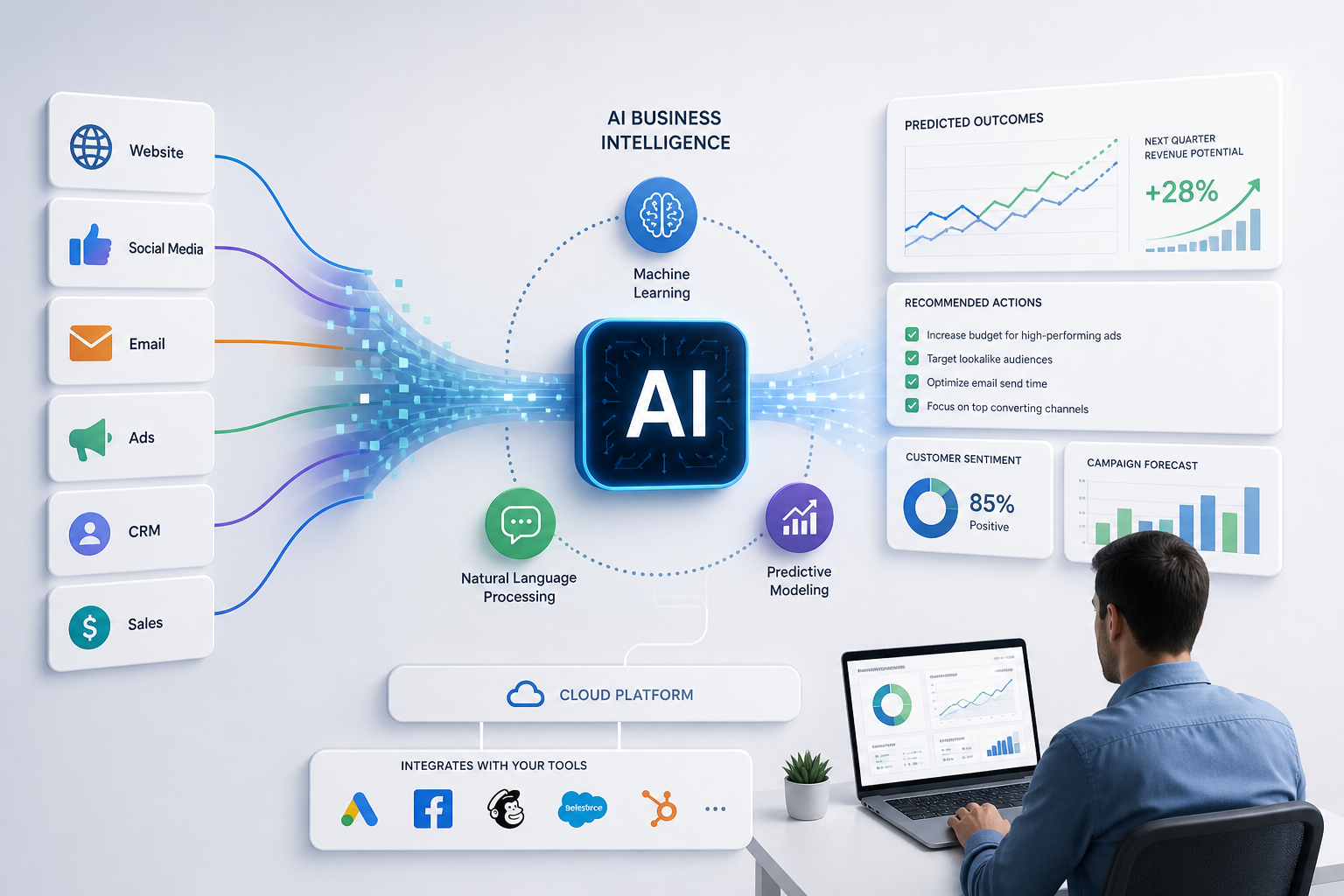
AI business intelligence refers to systems that collect, process, and analyze marketing data to generate actionable insights. Unlike traditional analytics tools that show you what happened last month, AI systems predict what will happen next quarter and recommend specific actions to improve outcomes.
The core components include machine learning algorithms that identify customer behavior patterns, natural language processing that analyzes customer sentiment across channels, and predictive modeling that forecasts campaign performance before you spend a dollar. These technologies work together to create a complete picture of your marketing ecosystem.
For small and medium-sized businesses, AI data analysis for small business has become particularly accessible. Cloud-based platforms now offer enterprise-level capabilities at fraction of previous costs. You no longer need a data science team to benefit from advanced analytics. The systems integrate with your existing marketing tools and provide insights through intuitive dashboards that speak the language of business results, not technical jargon.
Predictive Marketing Analytics: Seeing Around Corners
Predictive marketing analytics takes historical data and uses it to forecast future customer behavior with remarkable accuracy. The system learns from every interaction, purchase, and engagement to build models that predict which prospects will convert, which customers will churn, and which campaigns will deliver the strongest returns.
Consider customer acquisition costs. Traditional marketing tracks CAC after campaigns run, when the money is already spent. Predictive analytics calculates expected CAC before launch, allowing you to adjust targeting, messaging, or channels to hit your cost targets. This forward-looking approach turns marketing from a reactive expense into a proactive investment.
The technology also identifies micro-segments within your customer base that respond differently to various offers and messages. Where you might have previously created three or four campaign variations, AI can manage dozens of personalized approaches simultaneously, each optimized for specific customer characteristics. The result is higher conversion rates without increasing overall spend.
Churn prediction represents another critical application. The system flags customers showing early warning signs of disengagement, often weeks or months before they would typically cancel. Your team can intervene with retention offers targeted to specific concerns, saving customer relationships that would otherwise be lost. The financial impact of reducing churn by even 5-10% can be substantial for subscription-based businesses.
Optimizing Ad Spend with AI: Every Dollar Working Harder
Optimizing ad spend with AI addresses one of the most persistent challenges in marketing: allocation across channels and campaigns. Marketing directors face constant pressure to justify budgets while maximizing returns. AI provides the analytical foundation to make these decisions with confidence.
The technology monitors campaign performance across all channels in real time, automatically shifting budget toward high-performing placements and away from underperformers. This dynamic allocation happens faster than any human team could manage, capturing opportunities that would otherwise be missed and stopping losses before they accumulate.
Bid management in paid search and social advertising benefits particularly from AI analysis. The systems adjust bids hundreds of times per day based on factors like time of day, device type, geographic location, and competitive activity. These micro-optimizations compound into significant cost savings and performance improvements over time.
Attribution modeling becomes more accurate with AI business intelligence. Instead of relying on last-click attribution or simple multi-touch models, machine learning algorithms analyze the actual contribution of each touchpoint to conversions. You finally get clear answers about which channels and tactics deserve credit for results, informing smarter budget allocation decisions.
The impact on ROI is measurable and consistent. Organizations using AI for ad spend management report 25-40% improvements in cost per acquisition while maintaining or increasing conversion volumes. These gains flow directly to the bottom line, turning marketing from a cost center into a profit driver.
Building Your Data-Driven Marketing Strategy
A data-driven marketing strategy starts with clear objectives tied to business outcomes. Revenue targets, customer lifetime value goals, and market share objectives should drive your marketing metrics, not vanity numbers like impressions or reach. AI business intelligence systems need these targets to optimize effectively.
Data infrastructure forms the foundation. Your customer data must be centralized, clean, and accessible. This typically means implementing a customer data platform that integrates information from your CRM, website analytics, email marketing, advertising platforms, and point-of-sale systems. The AI can only be as good as the data it analyzes.
Start with high-impact use cases rather than trying to transform everything at once. Customer segmentation, campaign performance prediction, and channel attribution typically deliver quick wins that build organizational confidence in the technology. Success in these areas creates momentum for broader adoption.
Training your team is essential. Marketing professionals need to understand what AI can do, how to interpret its recommendations, and when to override automated decisions based on business context the system cannot know. The goal is human-AI collaboration, not replacement of marketing expertise with algorithms.
Measurement frameworks must evolve along with your capabilities. Traditional metrics still matter, but you should also track the accuracy of predictions, the speed of optimization cycles, and the lift from AI-driven decisions compared to manual approaches. These metrics demonstrate the value of your technology investment to stakeholders.
Practical Applications Across Marketing Functions
Content marketing benefits from AI analysis of topic performance, optimal publishing times, and content formats that resonate with specific audience segments. The system can predict which articles or videos will generate the most engagement before you invest in production, allowing you to allocate creative resources more effectively.
Email marketing becomes more sophisticated with predictive send time optimization, subject line testing at scale, and dynamic content that adapts to individual recipient characteristics. Open rates and click-through rates typically improve 20-30% when AI manages these variables compared to manual approaches.
Social media marketing gains precision through sentiment analysis, influencer identification, and optimal posting schedules. The technology monitors brand mentions across platforms, alerting your team to emerging issues or opportunities in real time. Paid social campaigns benefit from the same optimization capabilities as search advertising.
Product recommendations driven by machine learning increase average order values and customer satisfaction simultaneously. The algorithms identify patterns in purchase behavior that suggest complementary products or upsell opportunities, presenting offers at moments when customers are most receptive.
Customer service interactions generate valuable data that AI systems can analyze for insights into product issues, common questions, and satisfaction drivers. This information feeds back into marketing strategy, helping you address concerns proactively and emphasize features that customers value most.
Overcoming Implementation Challenges
Budget constraints often top the list of concerns, particularly for small and medium-sized businesses. The good news is that AI data analysis for small business has become increasingly affordable through SaaS platforms that charge based on usage rather than requiring large upfront investments. Start with one or two use cases and expand as you demonstrate ROI.
Data quality issues can undermine AI effectiveness. Dedicate time to cleaning your customer data, establishing data governance policies, and implementing processes to maintain accuracy going forward. This foundational work pays dividends across all your analytics efforts, not just AI applications.
Organizational resistance comes from fear of change and concerns about job security. Address these concerns directly by positioning AI as a tool that amplifies human capabilities rather than replacing them. Involve marketing team members in selecting and implementing AI tools so they feel ownership rather than threatened.
Technical integration challenges arise when connecting AI platforms to legacy systems. Work with vendors who provide strong integration support and consider middleware solutions that bridge gaps between old and new technology. The integration effort is temporary, but the benefits are ongoing.
Privacy and compliance considerations must be built into your AI strategy from the start. Ensure your data collection and analysis practices comply with regulations like GDPR and CCPA. Transparency with customers about how you use their data builds trust and reduces legal risk.
Measuring Success and Demonstrating Value
CFOs need clear financial metrics that connect AI investments to business outcomes. Calculate the cost savings from reduced waste in ad spend, the revenue lift from improved targeting, and the efficiency gains from automated optimization. Present these in terms of payback period and ongoing ROI.
Marketing directors should track performance improvements across key metrics like conversion rates, customer acquisition costs, and campaign ROI. Compare AI-driven results to baseline performance from manual approaches to quantify the technology’s contribution. Document case studies of successful campaigns that relied on AI insights.
Customer lifetime value improvements often represent the most significant long-term benefit of predictive marketing analytics. Track how AI-driven personalization and retention efforts impact CLV across different customer segments. These gains compound over time as you acquire better customers and keep them longer.
Speed to market represents another important metric. AI-driven testing and optimization allows you to launch campaigns faster and refine them more quickly based on performance data. This agility creates competitive advantages in fast-moving markets where timing matters.
Organizational learning accelerates when AI systems surface insights that humans can apply beyond specific campaigns. Track how often AI-generated insights lead to strategic shifts in positioning, product development, or market focus. These higher-order benefits justify continued investment in the technology.
The Competitive Imperative
Your competitors are adopting AI business intelligence whether you are or not. Companies that move first gain data advantages that compound over time. Their algorithms learn faster, their targeting becomes more precise, and their cost structures become more favorable. Waiting puts you at a growing disadvantage.
The technology barrier to entry continues to fall, making AI accessible to businesses of all sizes. What separates winners from losers is not access to technology but the commitment to building data-driven cultures and the discipline to act on analytical insights even when they contradict conventional wisdom.
Market dynamics increasingly favor data-driven competitors. Customer expectations for personalization rise as they experience it from leading brands. Generic marketing messages lose effectiveness as audiences become accustomed to relevant, timely communications. AI provides the only practical way to deliver personalization at scale.
Talent acquisition and retention benefit from modern marketing technology. Top marketing professionals want to work with advanced tools and data-driven approaches. Companies stuck in gut-feel marketing struggle to attract and keep the best people. Your technology stack signals whether you are a forward-thinking organization or falling behind.
Taking the First Step
Begin with an audit of your current marketing data and analytics capabilities. Identify gaps between what you can measure today and what you need to know to make better decisions. This assessment creates a roadmap for technology adoption and process improvements.
Select one high-value use case for an initial AI implementation. Customer segmentation, campaign performance prediction, or ad spend allocation typically offer good starting points. Choose something important enough to matter but contained enough to manage as a learning experience.
Partner with vendors who understand your business context and provide strong support during implementation. The right partner brings not just technology but expertise in applying it to marketing challenges. Look for case studies from companies similar to yours in size and industry.
Set realistic timelines and expectations. AI implementations typically show initial results within 60-90 days, but reaching full potential takes six months to a year as algorithms learn from your data and teams adapt to new workflows. Plan for this learning curve rather than expecting instant transformation.
Commit to ongoing refinement and expansion. Your first AI implementation should be the beginning of a journey toward comprehensive data-driven marketing, not a one-time project. Build on early successes by adding capabilities and extending AI to additional marketing functions over time.
The Path Forward
AI business intelligence has moved from experimental technology to essential infrastructure for competitive marketing. The question is no longer whether to adopt these capabilities but how quickly you can implement them effectively. Every month of delay means lost opportunities and higher costs compared to data-driven competitors.
The financial case is clear. Optimizing ad spend with AI, improving targeting through predictive marketing analytics, and building a comprehensive data-driven marketing strategy deliver measurable returns that justify the investment many times over. For CFOs tired of treating marketing as an unpredictable expense, AI provides the accountability and performance that turns marketing into a managed investment.
Marketing directors gain the tools to demonstrate value, defend budgets, and drive growth with confidence. The guesswork that plagued marketing decisions for generations gives way to data-backed strategies that perform consistently and improve continuously.
Small businesses benefit as much as enterprises from AI data analysis for small business. The technology levels the playing field, allowing smaller competitors to target as precisely and optimize as effectively as much larger rivals. The democratization of AI capabilities creates opportunities for agile companies to outperform established competitors.
Your next step is clear: assess your current capabilities, identify high-value opportunities for AI application, and begin building the data infrastructure and analytical capabilities that will define marketing success in the coming decade. The technology is ready. The question is whether you are prepared to lead your organization into this new era of data-driven marketing strategy.
How Elevated Marketing can help
We do this work every day for businesses in Indianapolis, the DC & Virginia metro, and nationwide.
→ Website Security & Monitoring→ SEO & GEO Services→ Managed Web Hosting→ Google Ads management in Indianapolis→ More on Digital Marketing & AIGet a free audit