
Every Marketing Admin and Small Business Owner knows the feeling: you log into your WordPress dashboard, see a red notification badge indicating that 14 plugins need to be updated, and a sense of dread washes over you. You know that clicking “Update All” is a gamble. Will the contact form stop working? Will the checkout page crash? Will the entire site go down with a fatal PHP error?
If you are terrified to update your own website because “something always breaks,” your business is suffering from a severe case of Technical Debt.
In software development, Technical Debt is the implied cost of future reworking caused by choosing an easy, short-term solution now instead of using a better, structural approach. For growing businesses, this debt usually takes the form of “plugin bloat”—the habit of installing a new third-party plugin for every minor feature over the course of several years.
Here is an executive breakdown of why website technical debt is quietly draining your revenue, posing a massive security risk, and why a professional plugin audit is the critical first step toward a scalable, enterprise-grade digital presence.
The Symptoms of WordPress Technical Debt
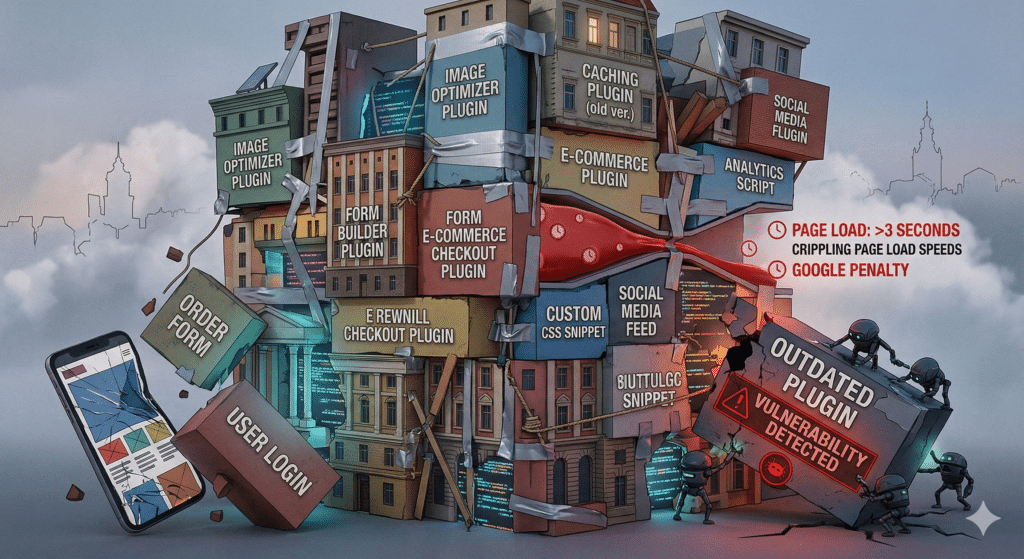
When a website is built by stacking dozens of disparate plugins from different developers on top of each other, the underlying architecture becomes incredibly fragile. This “duct-tape” approach to web development manifests in three highly destructive ways:
1. Crippling Page Load Speeds
Every plugin you install adds code to your website. Often, these plugins load their proprietary JavaScript and CSS files on every single page of your site, even if the plugin’s feature is only used on one specific landing page. This creates a massive bottleneck for browsers trying to render your content.
In 2026, Google’s algorithm heavily penalizes slow websites through its Core Web Vitals metrics. If your site takes longer than 2.5 seconds to load because it is bogged down by 40 conflicting plugins, your organic search rankings will plummet, and your advertising budget will be wasted on users who bounce before the page ever appears.
2. The “Frankenstein” Ecosystem and Constant Breakages
Plugins are created by independent developers all over the world. A plugin designed to optimize your images has no inherent knowledge of the plugin you installed to manage your caching or the plugin handling your e-commerce checkout.
When WordPress releases a core update, or when your server’s PHP version upgrades, these isolated plugins frequently conflict with one another. This is exactly why your site breaks when you update it. You are relying on a “Frankenstein” ecosystem of code that was never designed to work cohesively. This results in missing form submissions, broken mobile layouts, and thousands of dollars lost in potential sales while you scramble to find a freelancer to fix the conflict.
3. Critical Security Vulnerabilities
Perhaps the most alarming consequence of technical debt is the security liability. Industry data consistently shows that third-party plugins are the number one attack vector for hackers targeting WordPress sites. In fact, the vast majority of all WordPress security breaches originate from outdated or poorly coded plugins.
When you install a plugin and forget about it, or when you purposely avoid updating it out of fear of breaking your site, you are leaving known backdoors wide open. Hackers use automated bots to scan the internet specifically looking for sites running outdated versions of popular plugins, allowing them to instantly inject malicious code, steal customer data, or hold your site for ransom.
What is a “Tech Debt” Audit?
To escape this cycle of anxiety and constant breakages, businesses must undergo a comprehensive website plugin audit. This is not simply about clicking “update” and hoping for the best. It is a surgical process of evaluating your entire digital infrastructure to transition away from messy code.
A professional audit involves:
- Inventory and Assessment: Mapping every single plugin, script, and third-party integration currently running on the server.
- Performance Profiling: Identifying exactly which plugins are causing database queries to stall and which are actively destroying your site speed.
- Consolidation: Replacing 10 different single-feature plugins with one robust, custom-coded solution.
- Deprecation: Completely removing abandoned or “orphan” plugins that are no longer actively supported by their original developers.
The Elevated-Marketing Solution: Unified IT and Web Management
Transitioning away from a fragile, plugin-heavy WordPress site requires a partner who understands both the marketing front-end and the IT back-end. This is the exact intersection where Elevated-Marketing.io operates.
Instead of relying on a patchwork of temporary fixes, our team provides professional IT support for websites and comprehensive custom web development transition services. We conduct a rigorous Tech Debt Audit to identify your vulnerabilities and performance bottlenecks. Then, our developers consolidate your bloated infrastructure, hard-coding essential features directly into your theme to eliminate the need for vulnerable third-party plugins.
Furthermore, because we provide unified IT Managed Services, you never have to worry about clicking “Update” again. We manage your hosting environment, deploy updates in a safe staging environment first to ensure nothing breaks, monitor for security threats 24/7, and ensure your site remains lightning-fast and structurally sound.
You cannot scale a 2026 business on a foundation of 2018 technical debt. It is time to stop patching leaks and start building a secure, high-performance digital asset.