
You have optimized your meta tags, built a robust backlink profile, and published comprehensive, expert-level content. Yet, your organic traffic has flatlined, and you cannot seem to break through to the top three positions on the Search Engine Results Page (SERP). For SEO Managers and Small Business Owners, hitting this plateau is incredibly frustrating.
You might be auditing your content strategy looking for the missing piece, but the actual culprit is likely sitting in your IT department.
In 2026, the search algorithms have evolved. We are operating in an era where cybersecurity and SEO are inextricably linked. Google has made it clear that it will not send its users to a website that cannot guarantee their digital safety. Here is why the traditional “green padlock” (SSL certificate) is no longer enough to satisfy the Google E-E-A-T guidelines, and how integrating enterprise-level cybersecurity into your digital marketing strategy is the key to dominating the SERPs.
The Evolution of E-E-A-T: Trust is the Ultimate Multiplier
To understand the connection between IT infrastructure and organic rankings, we must look at how Google evaluates content. The algorithm utilizes a framework known as E-E-A-T: Experience, Expertise, Authoritativeness, and Trustworthiness.
While marketers spend the vast majority of their budgets proving their Expertise and Authority through blog posts and link building, Google’s own Search Quality Rater Guidelines explicitly state that Trustworthiness is the most critical component of the equation. Trust is the foundation; if your website is deemed untrustworthy, your expertise is irrelevant.
Historically, SEOs viewed “Trust” primarily as an off-page metric, measured by the quality of domains linking back to the site. Today, Trust is highly technical. Google evaluates the physical safety of your digital environment. If your website is vulnerable to data breaches, malware injections, or unauthorized access, the algorithm will actively suppress your rankings to protect its users.
The SSL Myth: Why the Green Padlock is Only the Baseline
For years, digital marketers treated website security for SEO as a simple checkbox: install an SSL certificate to migrate the site from HTTP to HTTPS, get the green padlock in the browser bar, and move on.
This is a dangerous oversimplification. An SSL certificate only encrypts data in transit between the user’s browser and your server. It does absolutely nothing to protect the server itself.
If your website is built on an outdated CMS with vulnerable plugins, an SSL certificate will securely encrypt the hacker’s connection as they inject malicious code into your database. Relying solely on an SSL for your cybersecurity is like putting a secure lock on your front door but leaving all the windows wide open. Google knows this, and its crawlers are looking for much deeper technical trust signals.
How Weak Cybersecurity Destroys Your SEO
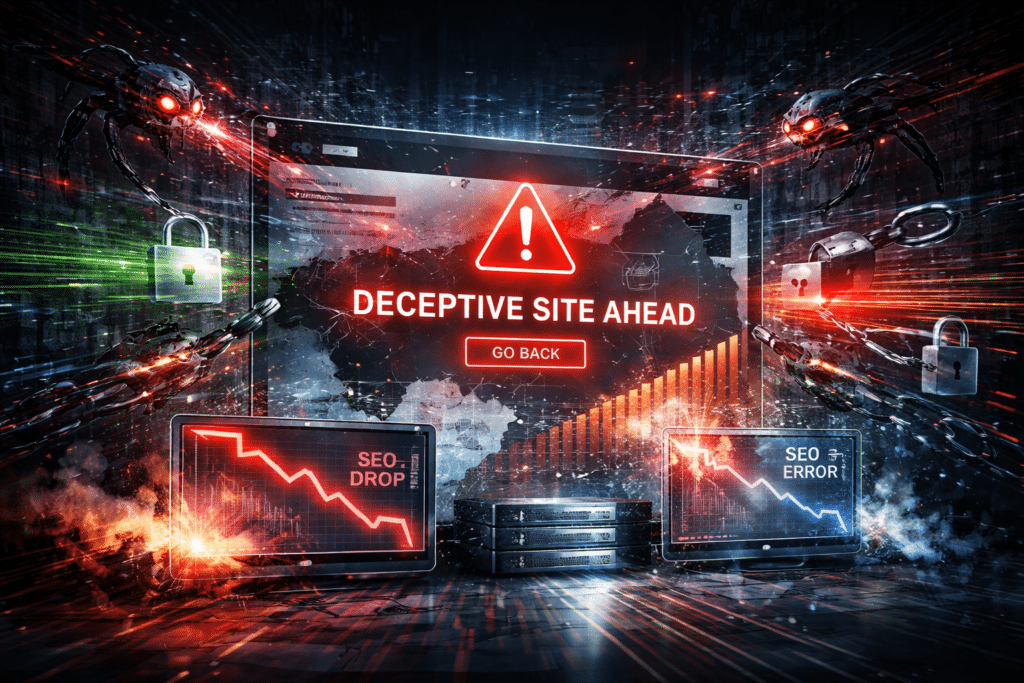
When your digital infrastructure is compromised, the SEO fallout is immediate and often catastrophic. Here is how a lack of cybersecurity directly impacts your organic visibility:
- The “Deceptive Site Ahead” Warning: Google uses Safe Browsing technology to constantly scan URLs for malware, phishing scripts, and deceptive software. If a hacker breaches your site and hides a malicious script in your code, Google will flag it. Users clicking your link will be hit with a massive red warning screen. This results in an immediate 99% bounce rate, completely destroying your algorithmic standing.
- Crawl Budget and Server Downtime: Cyberattacks like Distributed Denial of Service (DDoS) are designed to overwhelm your server, taking your site offline. If Googlebot tries to crawl your site and repeatedly encounters “503 Service Unavailable” errors, it assumes your business is closed or unreliable. Prolonged downtime leads directly to de-indexing.
- Loss of Data Protection Trust Signals: Modern search engines look for data protection trust signals. This includes compliance with privacy laws (GDPR, CCPA) and secure handling of user inputs. If your site processes lead forms or payment data without robust backend security, you fail the Trust evaluation.
How to Improve Google Trust Score Through Active Security
To break through your SEO plateau, you need to transition from passive security (just having an SSL) to active, proactive threat protection. Here are the core technical strategies to improve Google trust score and secure your rankings:
- Deploy a Web Application Firewall (WAF): A WAF sits between your website and the internet, actively filtering incoming traffic. It blocks malicious bots, SQL injections, and brute-force attacks before they ever reach your server. This not only keeps your site secure but significantly improves your server response time (a key Core Web Vitals metric) by blocking junk traffic.
- Conduct a “Tech Debt” Audit: Vulnerabilities often hide in outdated code. Regularly audit and consolidate your CMS plugins and third-party scripts. Removing deprecated, unsupported software closes the backdoors that hackers use to compromise sites.
- Implement Server-Side Malware Scanning: Do not wait for Google Search Console to tell you your site is infected. Implement automated, daily server-side scanning that detects and quarantines malicious file changes the second they occur, preserving your clean index status.
- Enforce Strict Access Controls: Human error is a massive security vulnerability. Implement Multi-Factor Authentication (MFA) and Zero-Trust access protocols for everyone who has backend access to your website, from your content writers to your web developers.
The Elevated-Marketing Advantage: Unifying IT and SEO
This technical reality highlights the fatal flaw of the traditional agency model. If you hire a marketing agency that only understands keywords, they will build a beautiful website that is a sitting duck for hackers. If you hire a traditional IT firm, they will lock down your server so tightly that they accidentally block Googlebot from crawling your pages.
At Elevated-Marketing.io, we have eliminated this disconnect. We provide a unified approach where elite digital marketers and seasoned cybersecurity professionals work on the same team.
When we engineer an SEO campaign, we simultaneously harden your IT infrastructure. We ensure that your digital presence is not only highly visible and authoritative but mathematically secure. By combining expert content with impregnable threat protection, we send the ultimate E-E-A-T trust signals to Google’s algorithm, allowing you to dominate the search results safely and sustainably.